
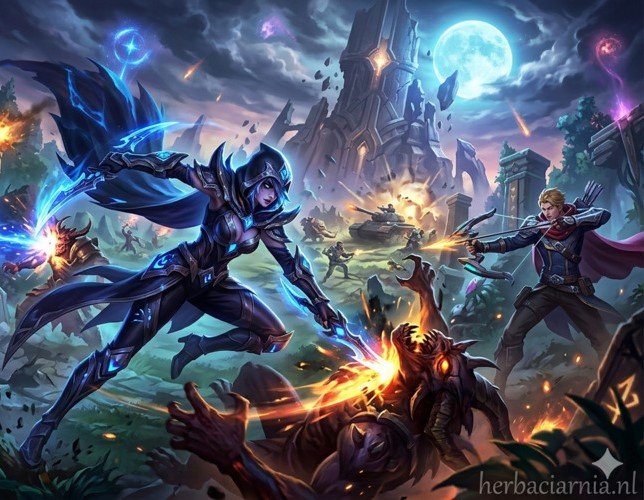
herbaciarnia.nl – Mobile Legends: Bang Bang has evolved into one of the most competitive mobile multiplayer games in the world. Millions of players enter the battlefield every day, each hoping to improve their rank, sharpen their skills, and achieve victory through teamwork and strategy. While basic mechanics and hero familiarity help players reach intermediate levels, advancing beyond that requires a much deeper understanding of how teams function, how battles develop, and how improvement occurs over time.
The difference between an average player and an elite competitor is rarely a single factor. Instead, it is the result of countless small advantages accumulated throughout a match. These advantages come from understanding hero synergy, mastering teamfight dynamics, and developing a long-term mindset focused on continuous growth. Players who embrace these concepts begin to see Mobile Legends not simply as a game of combat, but as a strategic environment where every decision influences future outcomes.
This guide explores these advanced concepts in detail and explains how players can elevate their gameplay to a higher competitive standard.
Hero Synergy and Team Composition Fundamentals
Many players focus heavily on selecting their favorite heroes without considering how those heroes fit into the overall team composition. While individual comfort is important, Mobile Legends is fundamentally a team-based game where heroes function as parts of a larger system.
A balanced composition provides damage, durability, crowd control, mobility, and utility. When one of these elements is missing, the team often struggles in specific situations. For example, a lineup with high damage but no frontline protection may dominate early skirmishes yet collapse during extended teamfights. Likewise, a composition with strong defense but insufficient damage may struggle to finish kills and secure objectives.
Understanding composition begins with identifying the role each hero plays within the team. Every pick should contribute to a broader strategic purpose rather than simply adding another source of damage. Teams that draft with synergy in mind create stronger opportunities for coordinated execution throughout the match.
The best compositions are not necessarily built around the strongest heroes. Instead, they are built around heroes that complement one another effectively.
Frontline and Backline Relationships
One of the most important aspects of team composition is the relationship between frontline and backline heroes. Tanks and fighters generally occupy the frontline, while marksmen, mages, and certain supports operate from the backline.
The frontline serves multiple purposes. It absorbs damage, creates space, provides vision, and initiates engagements. Without an effective frontline, backline heroes often struggle to survive long enough to contribute meaningful damage.
Meanwhile, backline heroes represent the team’s primary source of sustained output. Their success depends heavily on positioning and protection. A marksman dealing uninterrupted damage for several seconds can completely transform a fight, but only if frontline heroes successfully keep threats away.
Understanding this relationship helps players make smarter decisions during teamfights. Frontline heroes should focus on disruption and protection rather than chasing unnecessary kills, while backline heroes must prioritize survival and consistent damage application.
Strong teams recognize that these roles are interconnected. When one side performs effectively, the other becomes significantly more impactful.
Synergy Through Ability Interaction
Hero synergy extends beyond roles and includes the interaction of abilities. Certain combinations create opportunities that are far more powerful than what individual heroes can achieve alone.
Crowd control chaining is a classic example. A tank initiates with a stun, a mage follows with area damage, and an assassin finishes vulnerable targets before they can react. Individually, these abilities are useful. Together, they become devastating.
Similarly, some heroes excel because their abilities amplify teammates. Movement speed boosts, shields, healing effects, and vision tools can dramatically improve overall team effectiveness. These utility-based interactions often create advantages that are difficult to measure but highly influential in practice.
Players who understand ability synergy begin to think beyond their own hero. They actively seek opportunities to coordinate actions with teammates, maximizing the value of every engagement.
Teamfight Dynamics and Combat Execution
Many players believe teamfights start when abilities are cast. In reality, most fights are determined long before the first skill is used. Positioning, vision control, wave states, and cooldown management all influence the outcome before combat even begins.
Preparation starts with information gathering. Teams that know enemy locations can position themselves advantageously and avoid unfavorable engagements. Wave management also matters because pushed lanes create pressure that limits enemy movement.
Cooldown awareness is another crucial factor. Fighting while key ultimates are unavailable often leads to failure, regardless of mechanical skill. High-level players constantly track important abilities and adjust their aggression accordingly.
Effective preparation transforms teamfights from chaotic brawls into calculated engagements where success becomes significantly more likely.
Understanding Engagement Windows
Every team composition has moments when it is strongest. These moments are known as engagement windows. Recognizing them allows players to initiate fights under favorable conditions rather than forcing action randomly.
An engagement window may occur when an enemy uses a critical escape skill, when a powerful ultimate becomes available, or when a key damage dealer completes an important item. These temporary advantages create opportunities that skilled teams exploit immediately.
Timing is everything. Engaging too early may waste resources, while waiting too long allows opponents to recover. High-level players develop a strong sense of timing through experience and observation.
By understanding engagement windows, teams dramatically improve the efficiency of their fights and reduce unnecessary risk.
Target Prioritization During Teamfights
One of the most difficult aspects of teamfighting is determining who should be attacked first. Many players instinctively focus on the nearest target, but advanced gameplay requires more strategic thinking.
Target prioritization depends on threat level, positioning, and accessibility. Eliminating a high-damage enemy often provides greater value than attacking a durable frontline hero. However, pursuing a difficult target at the expense of positioning can create new problems.
The goal is not simply to deal damage, but to remove the most important enemy contribution from the fight. Sometimes this means eliminating a marksman. Other times it means disrupting a support or preventing a mage from casting critical abilities.
Strong teams constantly reassess priorities throughout the engagement rather than committing blindly to a single target.
Building Effective Practice Habits
Improvement in Mobile Legends requires more than playing large numbers of matches. Without structure, repetition alone often reinforces existing mistakes rather than correcting them.
Effective practice begins with focused goals. Instead of trying to improve everything simultaneously, players should concentrate on specific skills such as map awareness, positioning, or objective control. This targeted approach creates measurable progress and prevents overwhelm.
Reviewing gameplay is also valuable. Identifying recurring mistakes reveals patterns that may not be obvious during live matches. Many high-level players spend significant time analyzing decisions rather than simply playing more games.
Practice becomes more productive when it emphasizes quality over quantity.
Developing Consistency Across Different Matches
One challenge faced by many players is inconsistency. They perform exceptionally well in some games but struggle in others. Consistency is often the result of reliable decision-making rather than extraordinary mechanics.
Consistent players follow structured principles regardless of match circumstances. They prioritize objectives, manage risk carefully, and avoid emotional reactions. Because their decisions are grounded in strategy rather than impulse, their performance remains stable across a variety of situations.
Consistency also requires adaptability. Different opponents, teammates, and drafts create unique challenges. Players who can adjust while maintaining core principles achieve better long-term results than those who rely on rigid habits.
The goal is not perfection, but dependable execution over time.
Embracing Continuous Learning
Mobile Legends changes constantly through patches, hero adjustments, and evolving strategies. Players who stop learning eventually fall behind, regardless of previous success.
Continuous learning involves staying informed about meta developments, experimenting with new ideas, and studying high-level gameplay. It also requires humility. Even experienced players benefit from questioning assumptions and exploring alternative approaches.
Growth-oriented players view mistakes as opportunities for improvement rather than sources of frustration. This mindset accelerates development and makes setbacks easier to overcome.
The most successful competitors are often those who remain students of the game, regardless of rank or experience.
Conclusion Mobile Legends Advanced Guide: Hero Synergy, Teamfight Dynamics, and Long-Term Competitive Growth
Mobile Legends is far more than a test of mechanical ability. It is a strategic competition where hero synergy, teamfight execution, and long-term growth all contribute to success. Players who understand how compositions function, prepare effectively for engagements, and commit to continuous improvement gain advantages that extend far beyond individual matches.
Strong hero synergy creates coordinated opportunities that amplify team effectiveness. Advanced teamfight dynamics allow players to maximize their impact during critical moments. A structured approach to improvement ensures that progress continues over months and years rather than stagnating.
Ultimately, the path to mastery is not defined by a single breakthrough. It is built through countless small improvements accumulated over time. By focusing on teamwork, strategic thinking, and consistent development, players can transform their understanding of Mobile Legends and achieve a higher level of competitive performance.